
The sleek missile having 4000 km strike range is a two stage missile. It is 20 metre-long weighing 17 tonnes.

India on Sunday successfully test-fired its medium-range nuclear-capable Agni-II missile with a strike range of more than 2,000 km from the Wheeler Island off Odisha coast as part of a user trial by the army.

Buoyed by the string of successes with the intermediate range ballistic missile Agni-III, India is planning to test a missile with 5,000 km range soon. The launching of the 5,000-km range missile would entail strapping a third stage booster rocket on Agni-III missiles powered by a solid fuel propellant. The test of the next series of Agni missiles will propel the country into the select group of nations which have long range ballistic missiles.
If India's nuclear and missile capability before Agni-5 was not enough to deter China, then it is unlikely that Agni-5 will, argues Sushant Sareen
Indonesia's foreign ministry could lodge a formal protest over the incident, Transport Minister Hatta Rajasa reportedly said.

A lot of new technologies developed indigenously were successfully tested in the trial.

India on Friday successfully test-fired its indigenously developed nuclear-capable Agni-I ballistic missile with a strike range of 700 km from a test range off Odisha coast as part of a user trial by the army.
We will hopefully test-fire it before the end of the year, V K Aatre, Scientific Adviser to the defence minister, said.
In our euphoria over the successful Agni V test, we should not lose sight of the continuing gaps in tactical capabilities and the need to close them, writes B Raman

India on Monday successfully test-fired its nuclear-capable Agni-II missile intermediate range ballistic missile, with a range of 2000 kms, from the Wheelers Island off Orissa coast.
India on Thursday successfully test-fired the Agni-5 Inter-Continental Ballistic Missile, which was developed by the Defence Research and Development Organisation.The missile was test-fired from Wheeler Island in Odisha at 8.05 am.
India on Friday said it is developing a long-range nuclear-capable Agni-VI ballistic missile that would carry multiple warheads, allowing one weapon system to take out several targets at a time. "Agni-V is major strategic defence weapon. Now we want to make Agni-VI which would be a force multiplier," said Defence Research and Development Organisation chief V K Saraswat.

The call from T N Seshan, the then cabinet secretary to Prime Minister Rajiv Gandhi, relayed the pressure by the United States and NATO to delay the launch.
India is planning three more tests of the nuclear capable Agni-III missile with a range of 3000 km.

It was the third user trial in the Agni-III series carried out to establish the repeatability of the missile's performance.

India on Monday test-fired its nuclear-capable Agni-III ballistic missile with a strike range of more than 3,000 km as part of a user trial by the Army from Wheeler Island off Odisha coast, defence sources said.
It was the missile's third test flight. The first was on April 11, 1999 and second on January 17, 2001.

The medium range nuclear capable Agni-II missile was on Sunday successfully test-fired with a strike range of more than 2,000 km from the WheelerIsland off Odisha coast.
India "successfully" test-fired its nuclear-capable Agni-III ballistic missile with a range of more than 3,000 km from the Wheeler Island off the Orissa coast, on Sunday.
Making a quantum jump in its missile programme, India on Tuesday successfully test-fired a highly advanced nuclear capable Agni-4 long range ballistic missile with a strike range of 3,000 km from an island off Odisha coast.
India on Thursday successfully test-fired its nuclear capable Agni-I strategic ballistic missile, with a strike range of 700 km, as part of the Army's user trial from the test range at Wheeler Island off Odisha coast.
Two operational missile groups of the Indian Army -- one with the 150-250 km short-range Prithvi missiles and the other in charge of the longer-version 2,500 km Agni missiles, would form the nucleus of the new Strategic Forces Command.
India on Thursday conducted the maiden test of its indigenously developed nuclear capable Agni V ballistic missile with a strike range of over 5,000 km, from the Wheeler Island off Odisha coast.
Sharpening its missile teeth, India on Thursday successfully test-fired its medium range nuclear capable Agni-II missile with a strike range of 2000 km as part of a user trial by the army from the Wheeler Island off Odisha coast.
India's nuclear-capable, surface-to-surface Agni-II ballistic missile, with a strike range of 2,000 kms, was on Friday test-fired as part of user trial by the army from the Wheeler Island off Orissa coast.

"The experimental launch of Agni-II missile experienced a trajectory deviation immediately after the lift off resulting in failure of the mission," a DRDO spokesman said in New Delhi.

India on Monday successfully test-fired its nuclear-capable strategic missile Agni-IV, with a strike range of about 4,000 km, from a test range off the Odisha coast.
India on Thursday test-fired its nuclear-capable Agni-I strategic ballistic missile, with a range of 700 kms, as part of the army's user trial from the Integrated Test Range at Wheeler Island off Orissa coast.

The Advanced Systems Laboratory (ASL) in Hyderabad, which develops India's strategic (long-range, nuclear-tipped) missiles, has dramatically increased the options for its forthcoming Agni-5 missile by making it highly road-mobile, or easily transportable by road.
Once Agni-3 and Agni-5 are inducted into the forces, all the cities in China and Pakistan will be in India's range, Defence Research and Development Organisation Chief V K Saraswat said.
Two days after a perfect trial of the highly advanced Agni-IV weapon system, India on Friday successfully test-fired its nuclear-capable Agni-III missile with a strike range of over 3000 km from the Wheeler Island off the Odisha coast.
"The scientists have produced results. It is excellent...up to the point," he said.

Even without a sanctioned government project for the Agni-6, it seems inevitable that the Agni-5, over the next few years, will organically evolve into an ICBM with improved technologies and capabilities.

The indigenously made Agni V missile was test-fired from off the Odisha coast.
Adding teeth to its nuclear deterrence, India on Tuesday successfully test-fired an advanced variant of nuclear-capable Agni-II ballistic missile with a strike range of 3,000 km from an island off Odisha coast.
Defence Research and Development Organisation Director General Vijay Kumar Saraswat on Friday said the Agni-V missile, which took 30 years to be developed, was the best such thing in the 21st century. Agni-V is an intercontinental ballistic missile developed by the DRDO. It is part of the Agni series of missiles, one of the missile systems under the original Integrated Guided Missile Development Programme.

'Government officials use Gmail and ordinary phones without basic security consciousness.' 'Interoperability, especially in joint exercises with countries like the US, worries me.' 'It often means we open our systems to them, but they don't reciprocate.' 'They could have kill switches in their systems and might even be able to affect ours.'
India on Friday successfully test-fired the indigenously developed nuclear capable Agni-I ballistic missile, with a strike range of 700 km, as part of the Indian Army's user trial from a test range at Wheeler Island off Odisha coast.
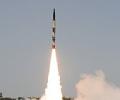
The surface-to-surface missile was test-fired from a mobile launcher at about 0830 hrs from launch pad-4 of the Integrated Test Range (ITR) at Wheeler Island, about 100 km from Balasore in Odisha, defence sources said.
